
Implementation of a Successful Burn
Burning Man embraces the use of fire as an art form in ways that no other event ever has, and we take as much pride in our safety record as we do our ability to burn. It is every artist’s responsibility to help Burning Man maintain this safety record, ensuring that we can all use fire in the ways that make our event one-of-a-kind.
Before you consider creating art that utilizes fire, you must take into consideration the following guidelines, compiled by Burning Man’s Fire Art Safety Team (FAST) to assist you with creating and exhibiting fire art safely. While we understand that these guidelines are extensive, it’s critical that you read them completely.
If you have any questions please contact:
General Questions: fire-art@burningman.org
Flame Effects: flame-effects@burningman.org
Pyrotechnics: pyro@burningman.org
Table of Contents: Planning for a Successful Burn
Step One – Pre-Playa Planning
– Read Safety Protocol Documents
Step Two – Pre-Playa Planning
- Fire Safety Perimeter Manager
- Perimeter Specifics
- Zones of a Burn
- Perimeter Size
- Safety Corridors
- Determine the Number of Safety Perimeter Crew
- Identifying Perimeter Crew
- Quadrant Zones & Perimeter Captains
- Communication
Step Three – On Playa
- Establishing a Perimeter
- Create the Initial Perimeter
- Ignition of a Burn
- When to Drop the Perimeter
- Contingency Plan
- Clean Up and LNT
- ARTery Check-out
Step Four – Post-Playa
- Submit Burn Report
Step One: Pre-Playa Planning
Read Safety Protocol Documents
Please read the following web pages to become familiar with Burning Man’s policies on creating art and fire art for the event:
Art Installation Guidelines
Playa Protection / Burn Scar Prevention
Creating Dangerous Art Safely
Step Two: Pre-Playa Planning
Designate a Fire Safety Perimeter Manager
Designate two people from your team to be the Fire Safety Perimeter Managers for your project. These two people (the artist him/herself can be one, if necessary) will be the point of contact for FAST and the BRC Rangers.
The Fire Safety Perimeter Manager roles are similar to being a Stage Manager, and they should possess the following qualities:
- Cool Head: ability to stay calm in the middle of chaos.
- Good Organizational Skills: ability to coordinate and manage the perimeter crew.
- Communication and People Skills: ability to communicate clearly at all levels, and communicate face-to-face instructions to perimeter team.
- Understanding The Big Picture: ability to set up in advance and manage the chain of command, the timeline for the perimeter set up, performance, and the rendezvous point for perimeter team, ensuring everybody knows exactly where he or she should be, what to expect, what to do, and who is in charge.
Perimeter Specifics
Zones of a Burn
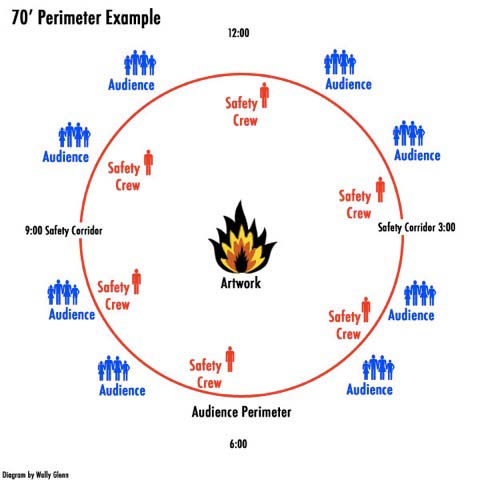
In preparation for a burn, the artist must clearly identify and set up the Burn Zones. The diagram below is an example of a 70’ radius perimeter. Starting from the inside and working outward, the Zones of a burn are:
- Artwork – The artwork is at the center; this is the area where the burn itself will take place. Just beyond the artwork is the Fire Zone, where the structure may fall. No participants are allowed in this area.
- Perimeter Dividing Line – This is the line that separates the audience from the Safety Perimeter Crew and is just inside which the Perimeter crew is stationed.
- Audience Viewing Zone – This is the area where the audience is located.
Determining Perimeter Size
The size of your artwork, the materials used for its construction, the type of fuels and fuel load needed and if you plan on using pyrotechnics are all factors that will go into determining the perimeter needed for your piece. Each project is required to have a half hour phone meeting with FAST pre-event. During that meeting the exact perimeter distance will be determined.
Establishing Safety Corridors
Larger burns require that you plan for placement of fire/emergency lanes and entrances for emergency and fire service vehicles. To identify and divide quadrants, and create Safety Corridors, Burning Man uses clock face designations. Normally the Safety Corridors would be placed at the 3:00 & 9:00 positions (see diagram above). FAST will help you with this planning.
Determine the Number of Safety Perimeter Crew
You will need a minimum of one front-line person on your perimeter crew for every 15 feet (4.5 m) of the perimeter’s circumference. Some simple examples:
- 50 foot (15m) radius circle requires a 21-person perimeter crew
- 100 foot (30m) radius circle requires a 45-person perimeter crew
- 200 foot (60m) radius circle requires a 84-person perimeter crew
- 300 foot (90m) radius circle requires a 123-person perimeter crew
FAST will make the final determination on the number of people required for your Safety Perimeter Crew based on all aspects of your project.
Perimeter Crew Identification
Make sure your Perimeter crew can be easily identified and distinguished from participants by the use of day-glo safety vests to be worn over their jackets or other outerwear.
Quadrant Zones & Perimeter Captains
For larger burns, divide the burn circle into four quadrants and number or name each one. Designate one person to take responsibility for each quadrant. Make sure everyone knows the name or number of his/her quadrant. This will make the task of locating emergencies or other issues easier for all involved.
Communication
Clear communication at all levels is essential. We’ve found that radio communication is great help for all burns and is a requirement for larger burns. In the event of a perimeter collapse, make sure all perimeter staff know not to put themselves between a surging crowd and a fire. All staff should go to the designated rendezvous point so that everyone can be accounted for. We require 3:05 O’clock on your perimeter to be your rendezvous point for perimeter volunteers.
Step Three: On Playa
Establishing a Perimeter
Most perimeters should be set at least two hours before the performance/burn. This timing is dependent on the project’s size, intensity and the complexity of your pre-burn activities. Pyrotechnic performances should have a perimeter established before the pyrotechnic load-in begins and the perimeter must remain in place until after the site has been declared safe. This initial pyrotechnic perimeter can be a smaller perimeter depending on the size of the structure, quantity and type of pyrotechnic material being used. A member of FAST who is certified for pyrotechnics will discuss this with you prior to your chosen burn day. A sufficient supply of fire extinguishers should be on hand from the beginning of the perimeter set up and must be visible and accessible at all times.
Create the Initial Perimeter
Form a tight ring of teammates arm-to-arm around the immediate performance area. Together as a group, proceed at a slow pace outward towards the eventual perimeter to ensure that foreign objects and non-crew participants are not within the perimeter. Be assertive, but polite. You are the host, they are the guests.
Once the perimeter has been set, your perimeter team must be diligent in keeping audience members out. Remember, the perimeter is there for their safety. Sitting is not recommended for the perimeter crew, as it is too difficult to spring into action from this position. Squatting, or crouching with one knee down is better. All members of the perimeter crew should have a flashlight or head-lamp for visibility and safety.
Additional team members may be needed to stand back from the front line of the perimeter crew to catch anyone who makes it through the perimeter line (this does happen). Before the performance, this second line can stand in for perimeter crew members when they need a bathroom break. Also, have some food and water available for your crew, and encourage them to bring warmer clothing to wear under their safety vest for a cooler evening.
Working with your audience is very effective and good humor is essential. Make friends with the audience; it is crucial that they assist you. Perimeter crews always face the crowd, with your back to the art piece. If you do not set up a perimeter before the audience arrives, it’s really difficult to get them to move back. Also, do not be too concerned if the crowd yells things like “burn it!” The crowd can sound surly, but they are at your burn to see the show and have a good time, just like you and your crew. For large performances, ask the first three or more rows of watchers to sit down. This way everyone can see and the likelihood of a sudden large perimeter break is greatly diminished. The people who arrive earliest for a performance often have cameras and are more than happy to sit. Since they would prefer others don’t trample their set up, they are typically more than willing to help you. Remember that in holding a perimeter, the situation can change quickly. The crew needs to stay focused and flexible throughout the event.
Ignition of the Burn
A member of FAST will arrive a few hours prior to the scheduled time of your burn to identify themselves to the artists. This time will be confirmed with FAST on playa. Refrain from adding fuel to the artwork before the FAST member arrives. The FAST member will make a final check of your piece, and if all is in order, they will issue the burn laminate for your piece, and inform the Black Rock Rangers and the Emergency Services Department that your piece is on schedule to burn. You may then proceed to fuel your piece and complete your preparations to burn.
Just before the burn, a FAST member will check the weather. Barring any high wind conditions or other negative weather factors you will receive an OK to burn from the FAST member.
When to Drop the Perimeter
For simple burns not involving pyrotechnics or large amounts of liquid fuels, the decision on when to drop the perimeter is based on when the highest pieces of the artwork have fallen. The idea is that a hazardous situation exists until any components of the artwork over seven feet tall that may conceivably fall, have actually fallen.
For larger burns FAST will help you to make this decision. For projects involving pyrotechnics, and not scheduled to burn completely, the pyrotechnics crew must make a sweep of the area for unfired pyrotechnics materials before the perimeter can be dropped at FAST’s direction. FAST will NOT allow a pyrotechnics crew member to enter a burning structure to check that the pyrotechnics have gone off.
Once the perimeter has been dropped, it is important to make sure that any unburned wood or other materials that have fallen outside of the burn shield are thrown back into the burn. It is important that these items do not become a tripping hazard for participants approaching the fire. If there are rebar, groundscrews/ground anchors or stakes protruding above the playa surface cones will be needed to place over them to alert participants. Once the perimeter has been released an overnight crew will stay with the embers to ensure participant safety and to prepare the area for clean up (LNT) in the morning. Do not allow participants to throw items that are not to be burned, like plastics or hazardous materials, into the fire.
Contingency Plan
If your burn plan goes like clockwork, great! But on the Black Rock Desert, you must be flexible and patient to have a successful burn.
- Having a back up plan (or two) is essential. One major factor to take into account is weather; the start of the burn performance may need to be placed on hold or cancelled and rescheduled for a different night.
- Know where the fire extinguishers are. All perimeter crew must be trained in the use of and aware of the location of the extinguisher closest to them. Have the Safety Perimeter Crew ready to respond at a moment’s notice. They should have eyes on the crowd. In the event of a perimeter collapse, make sure all perimeter staff know not to put themselves between a surging crowd and a fire.
- Rendezvous Plan – After the perimeter has dropped, all staff should go to the designated rendezvous point so that everyone can be accounted for. If possible, try to make sure the area outside the crowd is clear. In the event of a collapse, the surging crowd may respond by turning around and running back away from the fire.
The artist should be ready to stand by the art if the weather turns bad. A FAST member will be assigned to each burn and will be able to confirm your ignition timing. The FAST member will be the final word on wind and perimeter before the project can be lit.
Clean up and LNT
Post-burn, artists are also expected to completely clean the DG of debris. Completely cleaning the site of your burn is essential for the continuation of our event and it is your responsibility as the artist. Here is more information about burn clean up tools and LNT for fire artists.
ARTery Check-out
Once the burn site has been cleaned the artist should return to the ARTery to have an authorized ARTery team member return with them to the site of the burn. Only after this last review of your burn site will you be considered checked-out and able to leave the site.
Step Four: Post-Playa
In order to always improve we need to hear from you about your experiences with your burn. Artists will be required to write a short report post event describing what worked and what did not. This report is required before any DG deposits will be returned.
Questions
If you have further questions, please email fire-art@burningman.org