
Bookmark this page for future reference!
All participants using combustible fuels in their camps, an art installation or mutant vehicle (or for other purposes) at Burning Man must educate themselves about and comply with appropriate practices for storing and handling these materials. Not only is this essential for safety, but it is also required as part of our event permit stipulations with the Bureau of Land Management.
Fuel Storage Vs In Use
Fuel Storage is classified separately from “fuel in use.” Fuel in use includes fuel in generators, external tanks plumbed to diesel generators, fuel tanks connected to RVs or trailers and classified for cooking, fuel tanks connected to shower trailers, and fuel containers connected to a flame effect system. This fuel amount is not counted towards total fuel stored in a camp, art piece, or mutant vehicle.
The fuel storage limits for liquid fuels (gasoline, diesel, etc.) and liquefied petroleum gases (propane / LP-Gas) are treated separately and are not cumulative. Below, storage requirements for each and general fuel storage requirements are explained.
General Fuel Storage Requirements
Separation and Emergency Egress
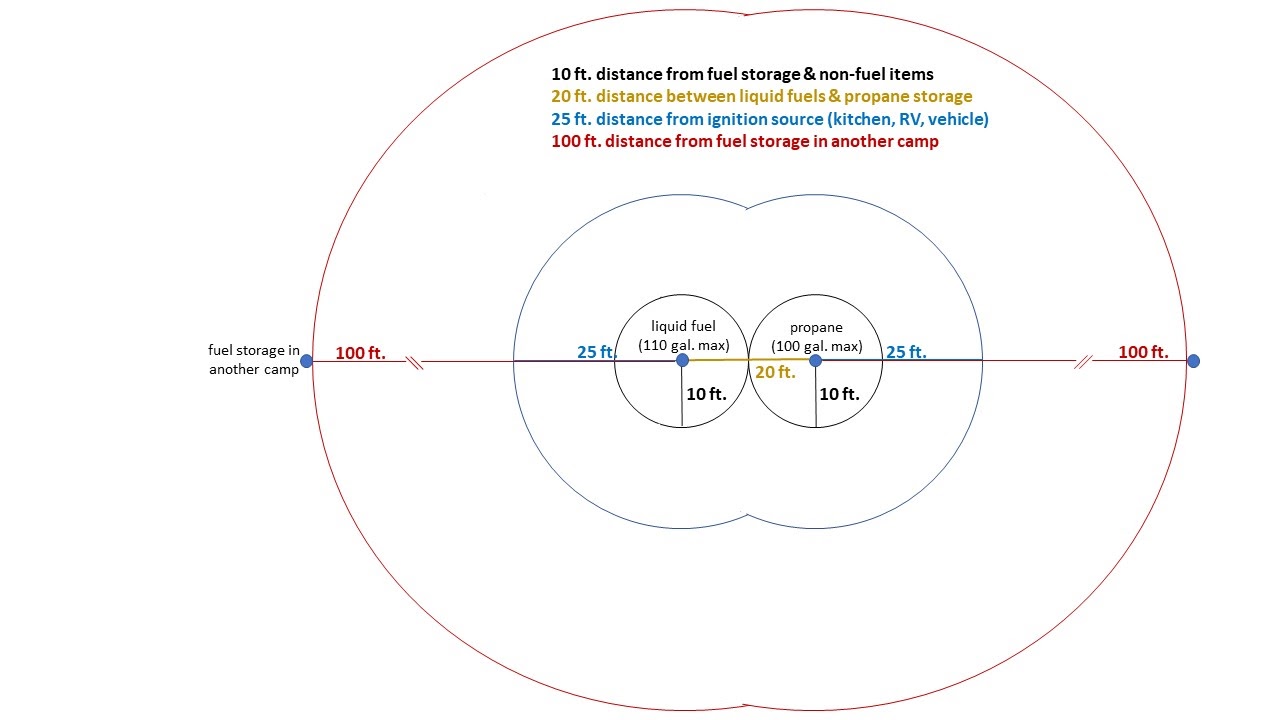
A distance of 10 ft. or greater must be maintained between any stored fuels (liquid fuels and compressed or liquefied fuel gases) and tents, equipment, public areas, RVs and all camp structures.
A distance of 20 ft. is required between liquid fuel storage areas and liquified petroleum gas (propane) storage areas.
A fire lane of 20 ft. shall be kept free of obstructions to provide emergency access for fire vehicles if needed. EXCEPTION: Fuel storage of less than 20 gallons does not require a fire lane.
A safety radius of 25 ft. must separate fuel storage from a source of ignition or heat sources such as burn barrels, grills/stoves, running generators, refrigerated trailers, RVs and vehicles.
No fuel storage area shall be closer than 100 ft. from another fuel storage area.
Vehicle Protection
All fuel storage areas must be protected from vehicle collision. A safety area of 10 ft. around the stored fuel should be marked as off limits using caution tape or other equivalent measures. To avoid vehicle collision, keep stored fuel at least 10 ft. away from a city street.
Storage Area Safety and Security
All fuel and flammables must be stored in approved containers that must remain closed except when filling, dispensing, or venting.
Fuel containers occasionally may need to be vented briefly due to vapor build-up in the high temperature environment. If you see that your container or drum is starting to bloat outwards, this can be a sign that there is a large build-up of fumes. Check to make sure there are no passing sources of ignition and slowly vent your container to release the excess pressure.
For fuel drums you can also purchase a ¾” pressure relief vent to go in the secondary bung hole. The non-vented cap should be used during transportation as the drum should not be transported with the vent in place.
Tanks and barrels should be secured to prevent tampering.
Proper signage of “NO SMOKING — FLAMMABLE” must be visible from all four directions.
At least one hand-held portable extinguisher with a 40-B rating is required for any fuel storage area. Extinguishers rated as ABC, AB, or BC will have a separate value for the B rating, which indicates the square footage of a class-B fire that a non-expert user should be able to extinguish with it.
Example: 5 Lb. 3-A:40-B:C Heavy Duty Plus Fire Extinguisher
Example of using a fire extinguisher correctly
The fire extinguisher must be placed 8 ft. – 10 ft. from the fuel storage area where it is visible and easily accessible.
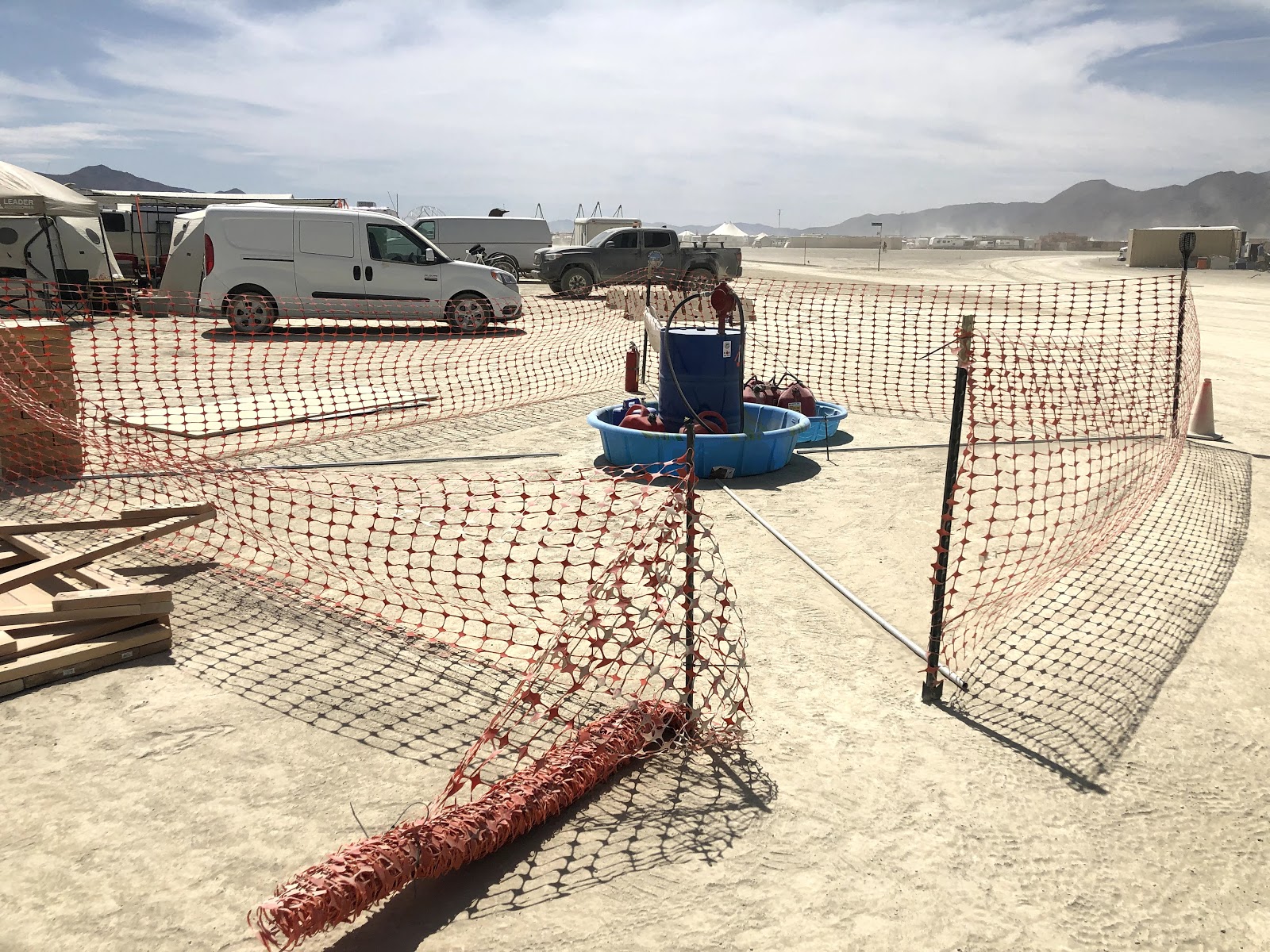
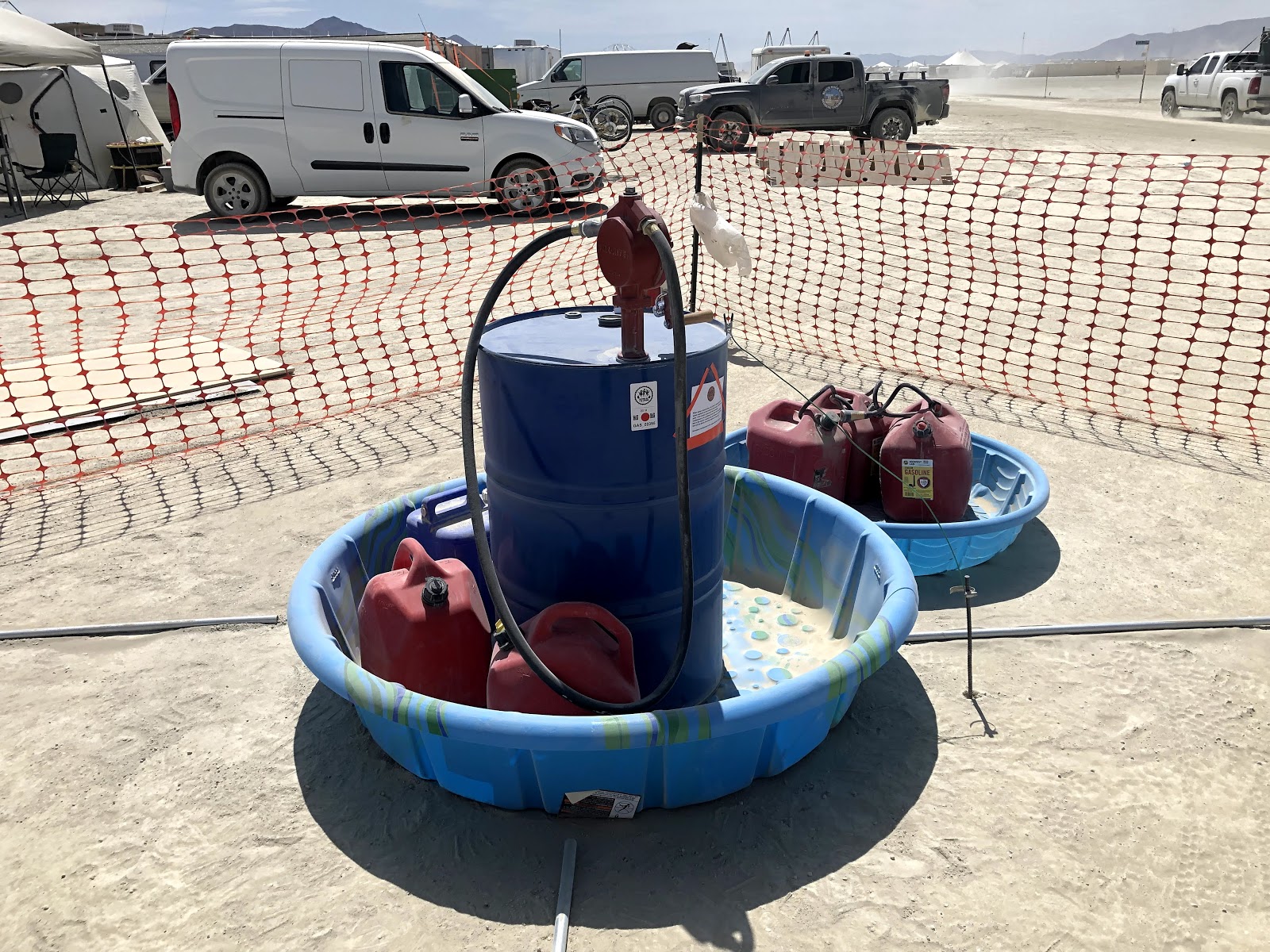
The secondary containment and fencing around the fuel storage area in these pictures are ideal. The fuel nozzle is in a holder that secures it above the barrel and prevents suction from draining all the fuel into the containment unit.
Commercially bought holders for fire extinguishers can be useful in making sure your fire extinguisher doesn’t walk off and that it is easily visible. To make a homemade one, take a 5 gallon bucket, fill it with concrete and put a pole in the middle. Add brackets to the pole to attach the fire extinguisher. The weight of the bucket should be enough to withstand the gale force winds of the playa.
Storage Location Diagrams
When participants submit their applications, they will be asked to provide diagrams showing:
- Base camp — where any fuels or hazardous materials will be stored within the camp.
- Art installation — where any fuels or hazardous materials will be stored in relation to your artwork.
- Mutant vehicles — where any fuels are installed on your vehicle for flame effects.
This information is needed to help the FAST (Fire Art Safety Team) and Emergency Services Department plan for emergencies.
Liquid Fuels
Liquid Fuel refers to Gasoline, Diesel (clear or dyed), Kerosene, Methanol, AvGas and Jet A Fuel. See the section below this for information on Compressed and Liquified Fuel Gases.
Quantity Limit
No more than 110 gallons or two 55-gallon drums may be stored in a camp at one time.
Villages, at least 200 ft. x 400 ft. in size, can have two fuel storage areas, maximum of 110 gallons each, as long as they are 100 ft apart and follow other fuel storage guidelines.
Note: D.O.T. and the State of Nevada prohibit transportation of more than 110 gallons of fuel in any vehicle without proper permitting, signage and required insurance. Arrangements can be made to have fuel delivered daily to larger generators or in drums through independent vendors with prior arrangement, which includes registration with OSS. Those providing transport of fuel should read these fuel delivery and transport guidelines.
Containers
Review the fuel container handout.
Fuel must be stored and transported in containers designed and rated for the type of fuel within, which includes 55-gallon drums rated for fuel and approved 5-gallon or smaller containers. Fuel containers should be CARB and EPA certified, large containers may be “UL” certified. Never use fuel containers that are degraded by the sun, cracked or damaged or are designed to hold water.
Fuel containers shall not be overfilled. Fuel containers (even little ones) should not be filled more than 80% of capacity to allow for heat expansion. Do not fill past the maximum fill line marked on containers.
Fuel containers must remain closed except when filling or dispensing fuel. A proper seal must be ensured on all lids, caps, bungs, or valves to prevent spills or leaks. All containers shall be securable to prevent tampering.
Fuel must not be stored in close proximity to any sources of artificially-produced heat that could cause the fuel to ignite, and must never be stored inside or under a living area such as a camper or RV. A minimum distance of 10 ft. is required between a fuel storage area and non-fuel items, the exception to this being shade specifically built for the fuel storage area. Fuel shall be stored at least 25 ft. from an ignition source.
Secondary Containment
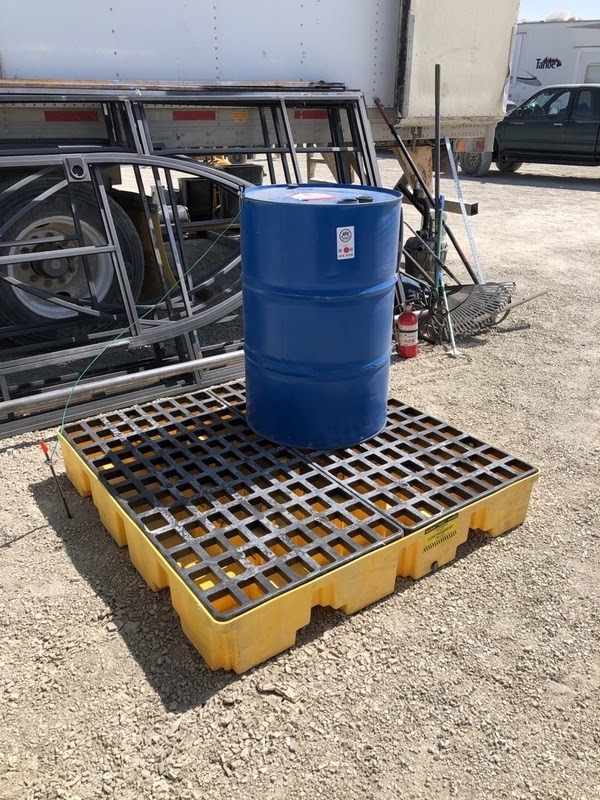
A secondary containment device or structure capable of holding 110% of the largest single container in the device is required. For example, a single containment device holding two 55-gallon drums needs a capacity of at least 60.5 gallons, and single or multiple five-gallon containers require a minimum of 5.5 gallons secondary containment.
Secondary containment is not restricted to professionally made containers but can consist of empty storage bins, small hard plastic children’s pools, or any non-flammable container capable of holding 110% of the volume of the largest container.
Secondary containment measures must comply with the following:
(a) The secondary containment system must be free of cracks or gaps and constructed of materials impermeable to the fuel(s) being stored; and
(b) The secondary containment system must be designed to allow the removal of any liquids captured resulting from leaks, spills or precipitation.
The backs of pick-up trucks or box trucks are not considered proper secondary containment as they are not sealed; however, a storage container may be placed within the bed of the truck and the fuel placed inside for transport.
Example: Eagle 1620 Spill Containment Pallet
Grounding and Bonding
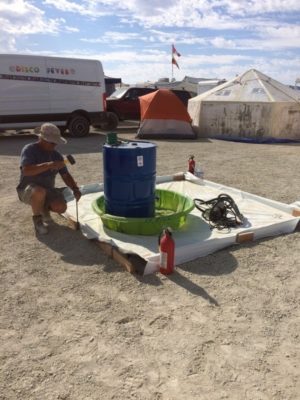
It is RECOMMENDED that fuel drums (e.g. 55 gallon metal drums) should be grounded and electrically bonded together at all times.
Drum stations must have a grounding rod installed. The ground rod must be deep enough to remain stable and must be attached to the drum with wire or equivalent. Ground and bonding clamps should not be removable by hand.
Participants must be able to bond equipment or containers being filled to the drum.
Handling and Transfer
When filling or dispensing flammable or combustible liquids, open flames or other ignition sources must be kept at least 25 ft. away.
No gravity fed tanks are allowed as fittings can break and cause large-scale spills. Electric or rotary hand pumps are preferable.
Note: Use proper electrical connections to reduce chances of spark and ignition. All electric pumps must be UL rated with proper ground bonding.
Example: 12V Fuel Transfer Pump / Rotary Hand Pump / Rotary Hand Pump 2
Hand pumps need extra precautions as fuel can leak out due to gravity. When not in use, you should always place the nozzle in a holder above the drum height, such as a nozzle hook on a pole. If the nozzle is placed in the secondary containment or in a position lower than the level of the fuel in the drum, a suction can be created and all of the fuel will be drawn out of the barrel in a big spill.
Fuel containers should be kept closed except when dispensing or receiving fuel.
Fuel spills are most likely to occur at the point of transfer. Take precautions to protect the playa surface by transferring fuel over a secondary containment or absorbent material. Burning Man Project recommends the use of a spill mat or appropriate tarp laid underneath the fuel-dispensing point when fueling vehicles or performing other transfers, to prevent any spills or overfills from contacting the playa surface.
Example: Oil/Fuel Spill Mat
Spill Control and Response
Preventing spills on the surface of the Black Rock desert is essential to our continued use of this resource for our event. It is also important to be good stewards of public lands and to leave no trace. The playa surface itself adds to the challenge because of its absorbent nature. Spill response and containment control materials should be kept on hand to deal with any spill quickly. Basic fuel spill kits should include a shovel and a sealable container for storage until you can take it with you post event for disposal if the contaminated playa can fit in a five gallon bucket. If the spill is larger than that, please report to Black Rock Rangers, Earth Guardians or the Emergency Services Department (ESD). Spill control measures shall be proportional to amounts of fuel stored.
Example: XSORB Spill Kit
Fuel spills with contaminated playa that cannot fit in a gallon bucket should be reported to Earth Guardians, Black Rock Rangers or ESD. Reports should include specific location and contact person at that location, who will remain on site until the response team arrives. Possible sources of ignition should be eliminated in the area of a spill. Vapors can travel significant distance away from the spill.
Fire Suppression Notes
DO NOT PUT WATER ON A LIQUID FUEL FIRE!
Call for Rangers and request ESD Response Team.
Safety Reminders
- Store fuel away from any running generator. As a source of ignition, this would constitute a distance of 25’.
- Do not fill the tank on a generator that is running.
- When transferring fuel, use a pump. Never try to start a siphon using your mouth. A mouth full of gas or diesel could be fatal to you. For health reasons, wash hands after fueling.
- Keep all equipment used for petroleum storage and handling in good condition. Watch for leaks, deterioration, or damage.
- If fuel is spilled on your clothing, move away from any ignition source, and allow the clothing to dry. Use waterless soap for hands. If fuel should splash in eyes, use clean water to flush.
- Be aware of static electricity that can build up on you and/or a container. Use proper grounding and bonding procedures when transferring fuel.
- Do not fill containers in vehicles.
Liquefied Petroleum Gases (propane)
Quantity Limit
Within Camps
The limit of Liquefied Petroleum Gas (LP-Gas) that may be STORED in a camp at one time is 500 lbs (120 Gallons).
The limit of LP-Gas used by flame effects (fuel IN USE) should not exceed the amount that can be used in a 24-hour period. This amount is subject to review and approval by FAST.
The limit of LP-Gas used by propane generators (fuel IN USE) should not exceed the amount that can be used between scheduled deliveries.
Refueling
Except for the specific locations listed below, propane tanks shall not be refilled in the city.
Propane is available for delivery to theme camps with registered flame effects on the Esplanade, 2:00, and 10:00 roads for cylinders of 100 lb. or greater capacity, and tanks of 25 gal. or greater capacity. There should be no transfer of LP-Gas within camps, the tanks/cylinders must be located within 50 ft. of the road and have clear access. Smaller cylinders and tanks can be filled at the Hell Station during normal hours of operation and transported back to your camp.
On Mutant Vehicles
In order to ensure the safety of participants and Emergency Services personnel, Burning Man Project imposes limits on the quantity of LP-Gas that may be carried on mutant vehicles. These limits are consistent with regulations imposed by the Nevada Department of Motor Vehicles and the Federal Department of Transportation (DOT), as well as National Fire Protection Association (NFPA) guidelines.
- The total Aggregate Gross Weight (weight of containers plus fuel when all containers are filled to their maximum permitted filling levels) shall not exceed 1000 lb.
- The maximum number of containers shall not exceed 10.
- The maximum size DOT cylinder shall be 1000 lb. water capacity (WC).
- The maximum size ASME portable container shall be 200 gallon water capacity (WC).
- ASME containers shall be designed for portable use, and shall have integral appurtenance protection.
- Containers shall be installed on the vehicle to allow adequate ventilation and access to their appurtenances for easy closure in an emergency situation.
- The containers shall be transported on the vehicle upright with the relief valve in communication with the vapor space preventing the venting of liquid LP-Gas.
- Containers shall be secured to prevent movement during transportation.
Note that Aggregate Gross Weight is only one consideration in sizing your fuel supply. Regardless of the size(s) of the cylinders you choose, you are limited to a total of 10cylinders maximum.
Below are some examples of LP-Gas cylinder combinations that meet the requirements:
- Ten 20 # cylinders = 380 lb = 46 gallons
- Ten 30 # cylinders = 550 lb = 68 gallons
- Ten 40 # cylinders = 720 lb = 92 gallons
- Five 100 # cylinders = 855 lb = 114.5 gallons
Containers
All propane cylinders’ requalification dates must be current, free of excessive rust and in serviceable shape.
The valve of a propane cylinder is required to be protected by a protective cap or collar, also called a neck ring. The absence of a protective collar leaves the cylinder valve(s) susceptible to serious damage. An unprotected valve hit hard enough can break off allowing liquid propane to escape at a dangerously fast rate. The escaping propane can act as propulsion for the cylinder, allowing it to become a dangerous projectile. The collar also serves as the location for required markings pertinent to the cylinder’s construction data and specifications. Without the protective collar, a propane cylinder is unfit for continued use and is illegal to fill.
The bottom of all propane cylinders are required to have a foot ring. The foot ring serves a very vital role in the protection and continued usability of a propane cylinder. The foot ring ensures the LP Gas cylinder stands in an upright and level position while also keeping the storage container from contacting the ground. Foot rings act as the “legs” of the cylinder and the absence of a foot ring would allow the bottle to easily fall on its side and roll around. If this occurred while the cylinder was in use, liquid may enter the service valve and hose resulting in a dangerous situation. Cylinders without a foot ring are unfit for continued use and are illegal to refill.
Consumer propane cylinders 4-40# are required to be equipped with an OPD (Overfill Protection Device) Valve.
Learn more about propane cylinder requirements.
Cylinder Storage and Care
All LP-Gas cylinders of any size must be stored in an upright position and secured to prevent tipping and potentially becoming an unguided projectile.
All cylinder valve protection caps are to remain on the cylinder valve assemblies unless in use.
Secondary Containment
LP-Gas cylinders do not require secondary containment.
Fire Suppression Notes
Have the appropriate hazard mitigations in place as well as fire extinguishers.
DO NOT EXTINGUISH A LEAKING PROPANE FIRE UNLESS LEAK CAN BE STOPPED.
Call for Rangers and request ESD Response Team.
Bookmark this page for future reference!